
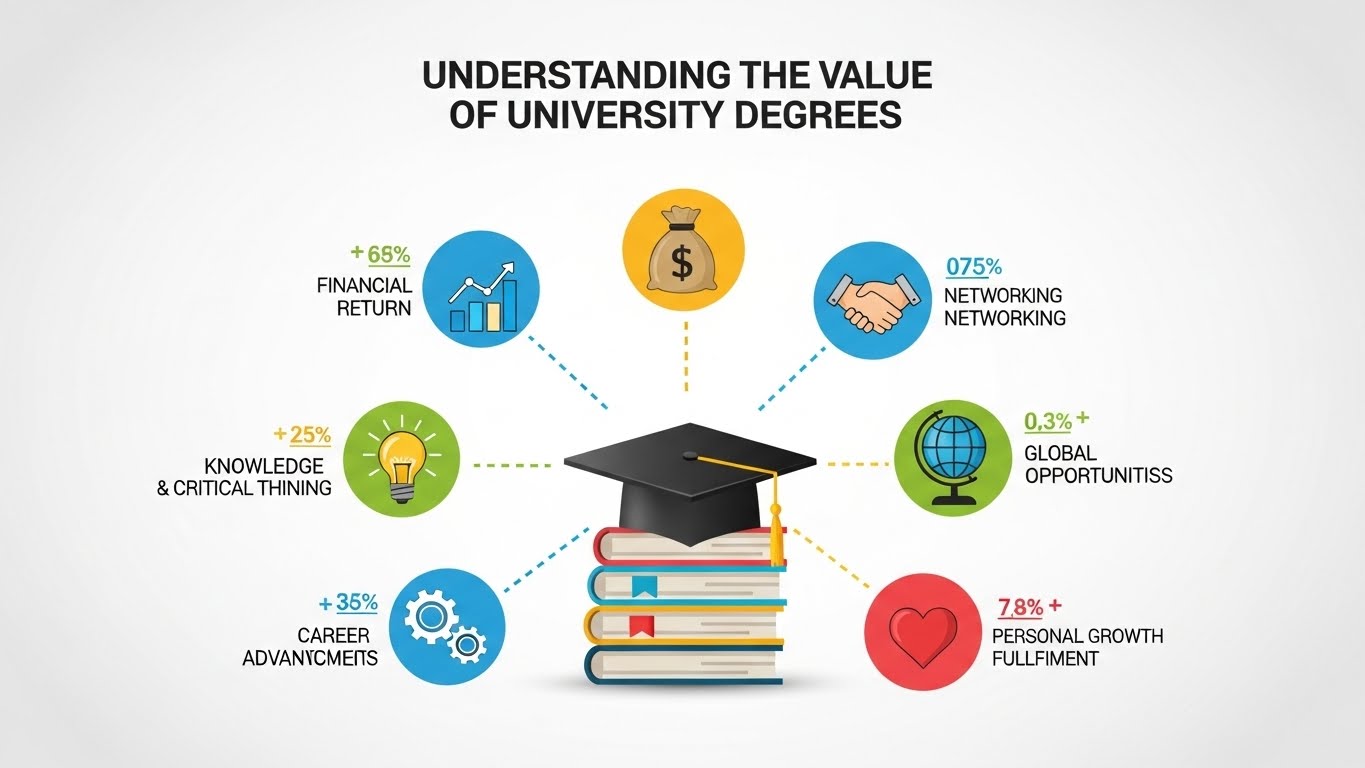
In today’s rapidly changing world, the value of a university degree is often discussed and sometimes questioned. With the rise of online learning, vocational training, and entrepreneurship, many people wonder whether a university degree is still worth pursuing. While success can be achieved through different paths, university degrees continue to hold significant value in terms of knowledge, career opportunities, personal development, and social impact.
This article explores the true value of university degrees and why they remain important in modern society.
1. Academic Knowledge and Intellectual Development
One of the most important values of a university degree is the academic knowledge it provides. Universities offer structured and in-depth learning in specific fields such as science, engineering, medicine, business, arts, and social sciences.
University education helps students:
- Gain specialized and advanced knowledge
- Understand theories, concepts, and research methods
- Develop analytical and critical thinking skills
This intellectual development allows graduates to approach problems logically and make informed decisions in their professional and personal lives.
2. Career Opportunities and Employability
A university degree often serves as a gateway to better career opportunities. Many employers require a degree as a basic qualification, especially for professional and technical roles.
The career value of a university degree includes:
- Access to a wider range of job options
- Improved chances of employment
- Eligibility for professional certifications and licenses
While skills and experience are important, a degree often provides credibility and opens doors in competitive job markets.
3. Higher Earning Potential
Research consistently shows that university graduates, on average, earn more over their lifetime compared to individuals without a degree. Higher education qualifies individuals for skilled and specialized jobs that offer better salaries and benefits.
Although earning potential depends on the field of study and experience, a university degree generally leads to:
- Higher starting salaries
- Greater opportunities for promotions
- Long-term financial stability
This makes higher education a valuable long-term investment.
4. Skill Development Beyond Academics
University degrees are not only about subject knowledge. Students develop a wide range of transferable skills that are highly valued by employers.
These skills include:
- Communication and presentation skills
- Teamwork and collaboration
- Problem-solving and critical thinking
- Time management and self-discipline
Such skills are applicable across many industries and help graduates adapt to different career paths.
5. Personal Growth and Confidence
University life plays a major role in personal development. Students learn to become independent, responsible, and confident individuals.
Through academic challenges and campus life, students:
- Build self-confidence
- Learn decision-making and responsibility
- Develop leadership and social skills
This personal growth helps graduates handle real-world challenges more effectively.
6. Networking and Professional Connections
Universities provide valuable opportunities to build professional networks. Students interact with professors, industry experts, alumni, and peers who may later become colleagues or business partners.
Networking benefits include:
- Job referrals and recommendations
- Internship and research opportunities
- Mentorship and career guidance
Strong professional connections often begin during university years and continue throughout a person’s career.
7. Preparation for a Changing Job Market
The modern job market is constantly evolving due to technology and globalization. University education prepares students to adapt to change by encouraging lifelong learning.
Graduates are better prepared to:
- Learn new skills
- Adjust to new technologies
- Change careers when needed
This adaptability increases long-term employability and career resilience.
8. Contribution to Society
University graduates often play key roles in society as doctors, engineers, teachers, researchers, managers, and leaders. Their education enables them to contribute positively to social and economic development.
Higher education helps individuals:
- Solve real-world problems
- Promote innovation and progress
- Participate actively in civic and social life
Educated individuals help build informed, productive, and responsible societies.
9. Global Recognition and Mobility
University degrees are often recognized internationally, allowing graduates to pursue opportunities abroad. This global recognition supports:
- International employment
- Further education overseas
- Cross-cultural collaboration
In an interconnected world, this global mobility adds significant value to a university degree.
10. Is a University Degree the Only Path to Success?
While university degrees are valuable, they are not the only route to success. Some individuals succeed through entrepreneurship, vocational training, or creative industries. However, for many careers, especially in professional and technical fields, a university degree remains essential.
The value of a degree increases when combined with:
- Practical experience
- Strong work ethic
- Continuous skill development
Frequently Asked Questions (FAQs)
1. Are university degrees still valuable today?
Yes, university degrees remain valuable as they provide recognized qualifications, skills, and access to professional careers.
2. Do employers still prefer university graduates?
Many employers prefer graduates because they demonstrate discipline, critical thinking, and specialized knowledge.
3. Is a university degree worth the cost?
For most people, the long-term benefits such as better job opportunities and higher earning potential outweigh the costs.
4. Can skills replace a university degree?
Skills are important, but many careers require both skills and formal qualifications provided by a university degree.
5. Does the field of study matter?
Yes, the value of a degree can vary by field, but transferable skills gained from any degree are valuable across industries.
Conclusion
Understanding the value of university degrees is essential in making informed educational and career decisions. A university degree offers more than just a certificate—it provides knowledge, skills, confidence, and opportunities that shape an individual’s future. While success can be achieved through multiple paths, university education remains a powerful tool for personal growth, career advancement, and societal development.
In a competitive and ever-changing world, the value of a university degree lies not only in employment prospects but also in the ability to think critically, adapt to change, and contribute meaningfully to society. When combined with practical experience and lifelong learning, a university degree continues to be a valuable investment in one’s future.